
When a client has two insurance policies, you bill the primary first; once it pays, you bill the secondary payer for the balance the primary didn't cover. Pabau carries the primary payer's payments and adjustment codes onto the secondary claim automatically, so the second payer has the coordination-of-benefits detail it needs without you re-keying anything.
The insurance billing module is available for practices in the United States and works with your connected Claim.MD account.
Before you start
A secondary claim is created from the primary claim, after the primary has paid. So you need:
- The primary claim in the Paid status, carrying the primary payer's line-by-line adjudication (each line's paid amount and adjustment reason codes) - that's the coordination-of-benefits detail the secondary is built from. The primary can be settled two ways: automatically by an electronic remittance (ERA), or by recording the payment by hand if that payer doesn't send ERAs (see below).
- The client's secondary policy details to hand - the payer and the member/policy number on that second card.
If the primary hasn't paid yet, finish that loop first (Guide Part 4 covers submitting and tracking to payment).
No ERA from the primary? Record the payment
Some payers pay on paper or by phone and never send an electronic remittance, so the claim would otherwise sit on Submitted forever - and you couldn't bill the secondary, which needs the primary's adjudication. To settle it by hand:
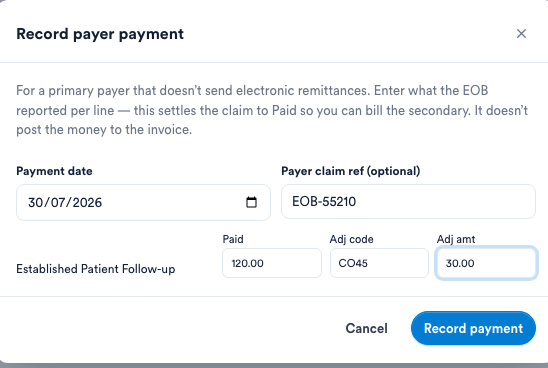
- Open the submitted primary claim and click Record payer payment.
- Enter the payment date and, per service line, the amount paid and any adjustment code (for example CO-45) and amount, exactly as the EOB reports them. Add the payer's claim reference if you have it.
- Click Record payment. The claim settles to Paid with the same line-by-line detail an ERA would carry, so you can bill the secondary straight after.
Recording the payment here settles the claim for tracking and secondary billing. Posting the money onto the invoice stays your normal payment step - it isn't done here.
Creating the secondary claim
- Open the paid primary claim from Money → Insurance claims (or from the client's Financials).
- In the settlement bar at the top of the claim - the one that reads "Paid" - click Create secondary claim. (It appears only once the primary is Paid with adjudication on file, whether from an ERA or a recorded payment.)
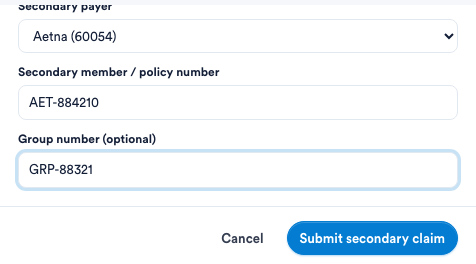
- In the dialog, choose the Secondary payer. If the client has a second policy on file that maps to one of your linked payers, Pabau offers it and pre-fills the member and group number for you; otherwise pick the payer and enter the client's member / policy number and group number for that second card.
- Click Submit secondary claim.
Pabau sends the claim to Claim.MD marked as a secondary (payer order: Secondary) with the primary payer's paid amount and adjustment reason codes attached to each service line -Nthat's the coordination-of-benefits information the second payer uses to work out its own liability.
Tracking the secondary
The secondary rides on the same claim as the primary, so you don't hunt for a separate record. The claim's settlement bar shows both results side by side - for example "Paid" for the primary and "Secondary: Submitted" (then Paid / Rejected / Denied as the second payer responds). When the secondary's ERA arrives, Pabau settles it and applies the payment to the same invoice, so the outstanding balance reflects what both payers have covered.

What gets carried across automatically
- The primary adjudication - each line's billed / allowed / paid amounts and the payer's CARC adjustment codes, taken from the primary settlement (the ERA, or the payment you recorded by hand) - not re-typed.
- The claim itself - patient, rendering provider, diagnoses and service lines are the primary claim's; you only supply the second payer and member number.
What you add is just the second policy's payer and member/policy number.

If the secondary is rejected
Secondary claims carry strict coordination-of-benefits maths, so the second payer can bounce one on the detail rather than the care. Two common ones: the primary payment date must be on or after the service date and not in the future; and per line, the primary's paid amount plus its adjustments must add up to the full charge. The rejection reason shows beside the status — correct the recorded primary payment if it's off, then create the secondary again.
What's next?
- Insurance Guide Part 4: Submit and track insurance claims
- How long does it take to process ERA and claims?
Questions about a specific secondary claim? Message us on live chat or email support@pabau.com.
Was this guide helpful? Let us know by voting below - your feedback helps us write clearer articles.
For more guides, browse the related articles below or use the search bar at the top of the page. You can also watch our video learning series, the Pabau Academy, or visit the Support page for additional help.