
When a client buys something at one of your locations but uses it at a different location, one location has effectively delivered value that another location was paid for. The Cross-Location Settlement report calculates the money owed between your own locations, so you can reconcile these inter-branch balances. It covers three types of prepaid benefit: Packages, Memberships, and Gift Cards.
For each of these, whenever the selling location and the redeeming location are different, the report records the value as a Receivable for the location that delivered the benefit (it should collect this from the other location), and a Payable for the location that originally took the money (it owes this to the other location). The same amount always appears once as a receivable and once as a payable, on opposite locations — so across the whole business, the two sides balance.
How to find it
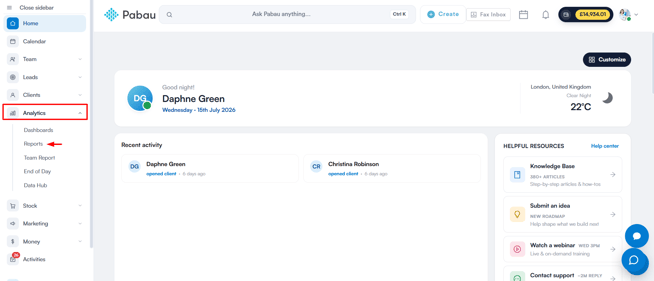
Step 1: Navigate to the Analytics Feature
Log in to your Pabau account, and in the left sidebar menu, go to Analytics, then click on the "Reports" button.
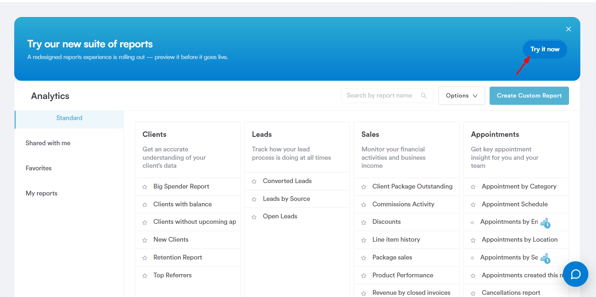
Step 2: Access the reports banner
On the "Try our new suite of reports" banner, click Try it now.
Once you're in the new reports view, go to the PabauPay section and click on the Cross-Location Settlement to open the report.
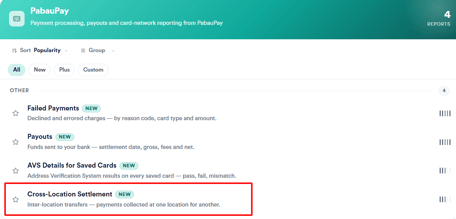
NOTE: The PabauPay section is only visible if your staff account has the "Can access business company reports" permission. If you can’t see it, ask an administrator to grant that permission.
Filters
- Date range – Required. If you don't set one, the report defaults to the last 30 days. Quick presets are available (Today, Last 7 days, Last 30 days, Last 90 days), and the maximum range you can select is 365 days. Note: for memberships and gift cards, the date used is when the payment/redemption was taken. For packages, it's the date of the booking where the session was used. All dates are interpreted in your clinic's local time zone.
- Locations – A multi-select, defaulting to All locations. You'll only ever see locations you're permitted to access, and the figures shown are limited to those locations too.
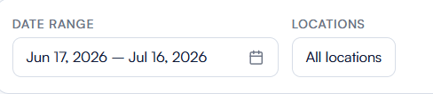
NOTE: The figures reload automatically as soon as you change the date range or location filter. Use Refresh when you want to re-pull the latest data without changing your filters.
Understanding the report
The KPI cards
Four summary cards sit below the filters, all using your account's currency format.
| Card | What it shows |
|---|---|
| Total Receivable | The total amount owed to your locations across all categories. |
| Total Payable | The total amount owed by your locations across all categories. |
| Net Balance | The difference between receivable and payable — shown as "+X receivable" if positive, "X payable" if negative, or "Balanced" when the two sides are within a rounding cent of each other. |
| Active Locations | How many of your locations had at least one cross-location receivable or payable in the period, with the total number of locations on your account shown alongside. |

NOTE: Because every cross-location transaction is booked as both a receivable and a payable, Total Receivable and Total Payable will normally be equal, and the Net Balance across the whole business will normally show Balanced.
The Net Balance becomes most useful once you filter down to a single location or a subset of locations — that's when it tells you whether that selection is a net creditor or net debtor to the rest of the business.
The settlement table
The main body of the report is a table with one row per location, and grouped columns per benefit category (Package, Membership, Gift Card). Each category has two columns:
- Receivable – what this location should collect from other locations, for benefits it delivered against items sold elsewhere.
- Payable – what this location owes other locations, for items it sold that were redeemed elsewhere.

You may need to scroll horizontally to see all three categories. Only locations with actual cross-location movement in the period appear as rows, sorted alphabetically, and amounts of zero are shown greyed-out so the values that matter stand out. The bottom row totals each column across all listed locations.
NOTE: If nothing sold at one location was redeemed at another during the selected period, the table shows "No cross-location settlements," with a hint to widen the date range or clear the location filter.
Drilling into a figure
Every non-zero amount in the table — including the cells in the totals row at the bottom — is a clickable blue link. Clicking one opens a payment list in a new tab showing the exact payments that make up that figure, so you can trace any settlement amount back to the individual transactions behind it, to the penny.
How each category is calculated
For any benefit, Pabau identifies a selling (origin) location — where the client originally paid and a redeeming location — where the benefit was actually used. If these are the same, nothing is recorded, since it isn't a cross-location event.
- Packages – Each used session is one settlement event, valued at the package's purchase price divided by its total number of sessions (for example, an £800 package of 5 sessions settles at £160 per session, not the full list price of the service booked). If a package's session count is missing or zero, that session contributes nothing rather than an incorrect full-price amount.
- Memberships – Each membership benefit redeemed (paid using the "Membership" payment method) is one settlement event. The selling location is based on the earliest activation invoice for that client and membership; the redeeming location is where the benefit was actually used.
- Gift Cards – Each redemption paid with a voucher is one settlement event, based on where the gift card was sold versus where it was redeemed. Gift cards that have been refunded or cancelled are excluded.
Excluded everywhere: same-location redemptions, zero or negative amounts, and credit-note payments.
Toolbar controls
In the top-right corner of the report you’ll find the standard report actions:
| Button | What it does |
|---|---|
| Columns | Opens the column manager, letting you hide or show the Receivable and Payable columns for each category. |
| Export | Downloads the settlement table as a CSV file, reflecting your current filters. |
| Opens a print-friendly version of the report, laid out in landscape. | |
| Help | Opens the built-in help panel explaining the report. |
| Refresh | Re-runs the report to pull in the latest data. |
By following these steps, you can use the Cross-Location Settlement report to see exactly how much your locations owe each other, and trace any figure back to the transactions behind it.
Was this guide helpful? Let us know by voting below - your feedback helps us write clearer articles.
For more guides, browse the related articles below or use the search bar at the top of the page. You can also watch our video learning series, the Pabau Academy, or visit the Support page for additional help.