
Table of Contents:
1. How to Create a Product
2. How to Edit a Product
3. How to Deactivate a Product
4. How to Create Suppliers
5. How to Build a Purchase Order
6. How to Start a New Inventory Count
How to Create a Product
Creating products in Pabau is a crucial aspect of managing your stock efficiently. Follow these detailed steps to add a new product to your inventory:
Step 1: Navigate to Products
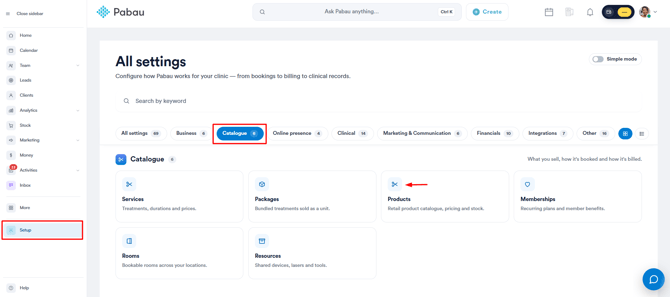
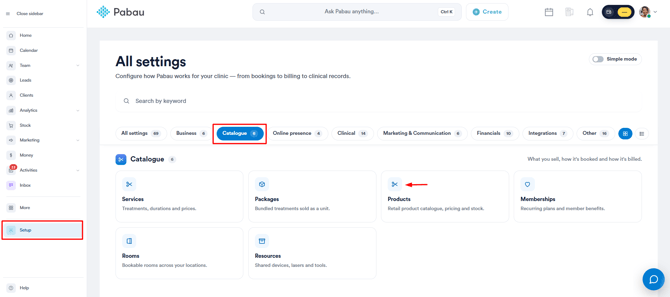
Log in to your Pabau account and in the left sidebar, click Setup. Then, under ''Catalogue'', click Products.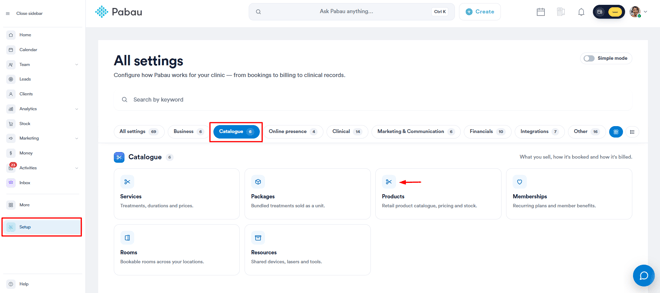
Step 2: Create a Category
If you don't have any existing products or categories, start by creating a category. Switch to the "Categories" tab in the top left corner, then click on "New Category."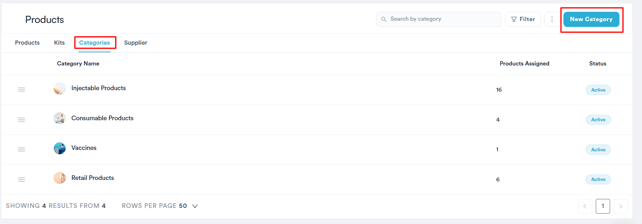
Provide a name for the category and select a category type. Other fields are optional. Click on "Create" to complete the category creation. 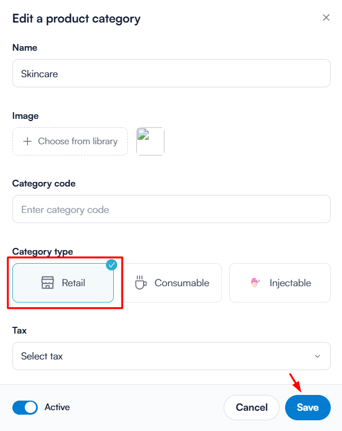
Step 3: Create a New Product
Switch to the "Products" tab, then click on "New Product" in the top right corner.
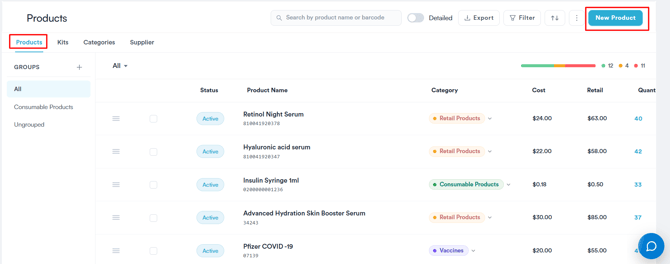
Once you click New product, the Create Product page opens. At the top you’ll see three tabs:
- General
- Pricing
- Inventory level
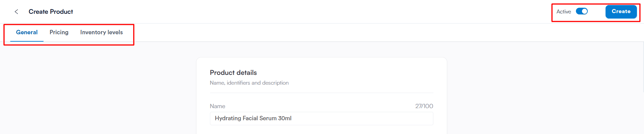
Use Active in the top right corner to choose whether the product can be used. It’s switched on by default. When you’ve filled in the details, click Create to save the product.
General Tab
The General tab opens first and has these sections:
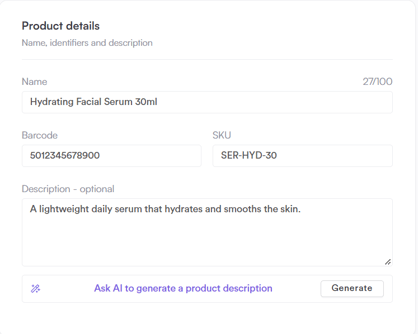
- Product details
- Name: enter the product’s name (up to 100 characters).
- Barcode: enter the product’s barcode, so it can be scanned at the point of sale. This is optional.
- SKU: enter your own stock code for the product, such as “CRM-HYD-50”. This is optional.
- Description (optional): add a short description of the product. To get help writing it, click Generate in the Ask AI to generate a product description box.
BARCODE: Make sure that you have the same barcode on the product added in the system before scanning, and then try to scan it again. If the barcode in the system does not match the physical barcode on the product, the scanner will not recognize it.
SKU: Make sure to check that the SKU is correct before saving. The SKU is the unique identifier used to track the product across the system — including inventory counts, purchase orders, and reports. An incorrect SKU can cause discrepancies in stock tracking and make it harder to reconcile your inventory accurately.
- Classification
- Category: choose the category the product belongs to, such as Skincare. Categories group your products in lists and reports.
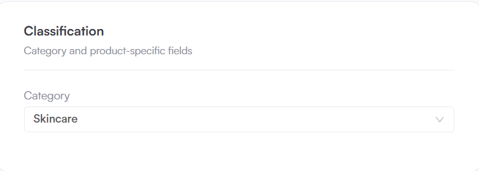
- Category: choose the category the product belongs to, such as Skincare. Categories group your products in lists and reports.
- Measurement & dosage
- Measure: choose how the product is measured and dispensed. The default is A whole product, which suits items that are sold one at a time.
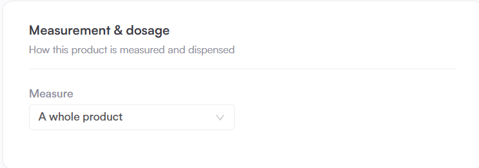
- Measure: choose how the product is measured and dispensed. The default is A whole product, which suits items that are sold one at a time.
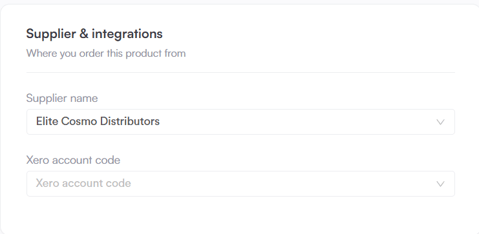
- Supplier & integrations
- Supplier name: choose the supplier you order this product from.
- Xero account code: choose the Xero account code used for this product. This is for clinics that use the Xero integration.
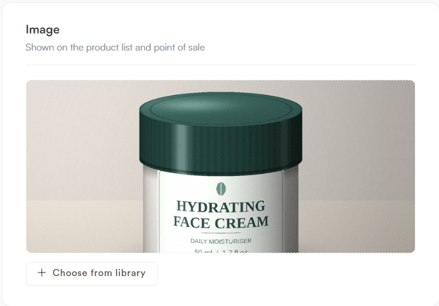
- Image
- Upload a picture of the product. It’s shown on the product list and at the point of sale.
- Upload a picture of the product. It’s shown on the product list and at the point of sale.
- Additional fields
- These are custom fields set up for products in your account, such as Lot Number. Fill in the ones that apply to your product. The fields you see depend on how your account is set up.
- These are custom fields set up for products in your account, such as Lot Number. Fill in the ones that apply to your product. The fields you see depend on how your account is set up.
Pricing Tab
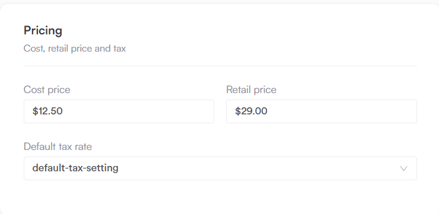
Click the Pricing tab to set what the product costs you and what you sell it for.
- Cost price: enter what you pay your supplier for one unit of the product.
- Retail price: enter the price you sell the product to clients for.
- Default tax rate: choose the tax rate applied to this product. It shows default-tax-setting to start with, which uses the tax setting from your account. Change it only if this product needs a different rate.
Inventory Tab
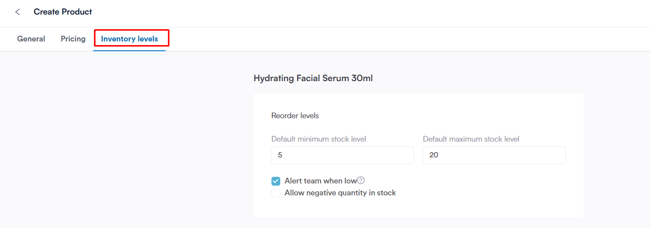
Click the Inventory levels tab to set when you want to reorder the product and how much you have in stock at each location. The name of the product you’re creating is shown at the top.
- Reorder levels
- Default minimum stock level: enter the lowest quantity you want to keep in stock before reordering.
- Default maximum stock level: enter the most you want to hold in stock.
- Alert team when low: keep this ticked if you want your team to be alerted when stock is running low. Hover over the ? icon next to it for more information.
- Allow negative quantity in stock: tick this if you want to be able to sell the product even when the quantity in Pabau has reached zero. It’s unticked by default.
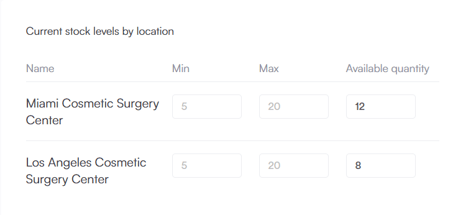
- Current stock levels by location
- This table lists each of your locations with its Min, Max and Available quantity for the product.
- Enter the Available quantity to record how many units you have in stock at each location.
By following these steps, you can efficiently add and manage products in your Pabau account.
How to Edit a Product
Ensure your product details are always up-to-date by following these steps to edit a product in Pabau:
Step 1: Navigate to Products
Log in to your Pabau account and in the left sidebar, click Setup. Then, under ''Catalogue'', click Products.
Step 2: Locate the Product
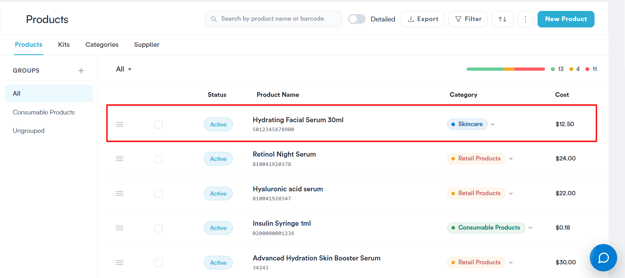
Locate the product you wish to edit in the Products list and click on it.
Step 3: Edit Product Details
In the "Edit Product" page, make the necessary changes to the product's details, such as name, category, measure, supplier, pricing, or inventory. The editing process is similar to creating a new product.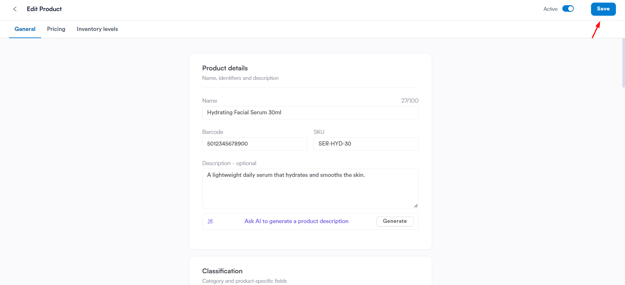
Modify the required fields as needed.
Step 4: Save Changes
Once you have made the necessary changes, click on "Save" in the top right corner to save the edits.
By following these steps, you can effortlessly update and modify product details in Pabau, ensuring your inventory management remains accurate and efficient.
How to Deactivate a Product
Keep your product list tidy by making products you no longer sell inactive. Products can’t be deleted in Pabau, so switching a product to inactive is how you take it out of use.
Step 1: Navigate to Products
Log in to your Pabau account and in the left sidebar, click Setup. Then, under ''Catalogue'', click Products.
Step 2: Locate the Product
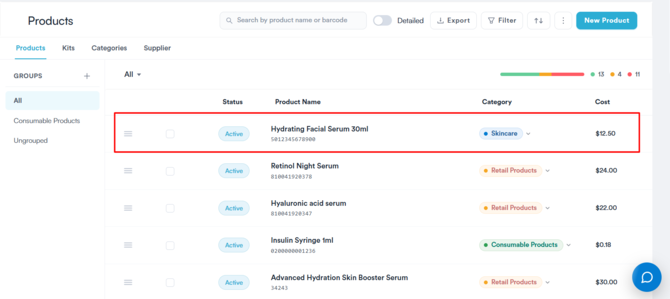
Locate the product you wish to delete in the Products list and click on it.
Step 3: Switch the Product to Inactive
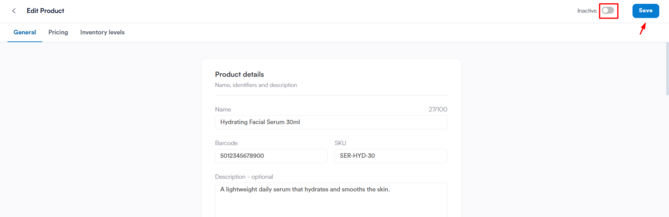
On the Edit Product page, find the Active toggle in the top right corner and switch it off. Then click Save to apply the change.
NOTE: Products can’t be deleted. Making a product inactive is the only way to remove it from use.
To use the product again: open it from the Products list, switch Active back on and click Save.
By following these steps, you can keep your product list up to date by switching off the products you no longer need.
How to Create Suppliers
Adding product suppliers with their company details is essential for efficient purchase order management. Follow these steps to create a supplier in Pabau:
Step 1: Navigate to Products
Log in to your Pabau account and in the left sidebar, click Setup. Then, under ''Catalogue'', click Products.
Step 2: Switch to the Suppliers Tab
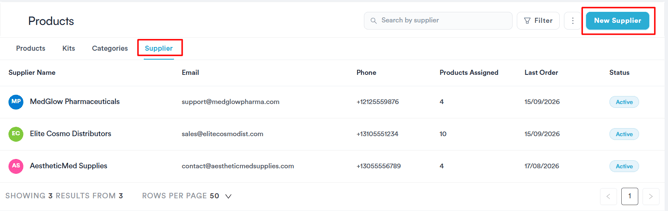
Switch to the "Suppliers" tab on the left side of the screen, then click on "New Supplier" in the top right corner of the screen.
Step 3: Input Supplier Details
On the Create Supplier page, fill in the details of the supplier in the three sections below. At the top right, the Active toggle is switched on by default. When you’ve finished, click Create to save the supplier.
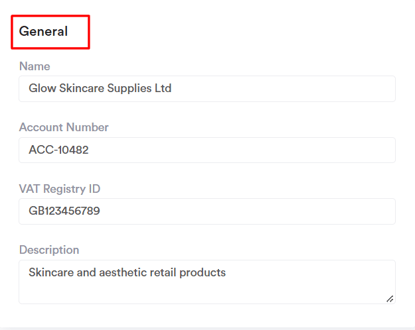
- General
- Name: enter the supplier’s name. This is the name you’ll choose when you add a supplier to a product.
- Account Number: enter your account number with this supplier, if they’ve given you one.
- VAT Registry ID: enter the supplier’s VAT registration number.
- Description: add a note about the supplier, such as what they supply.
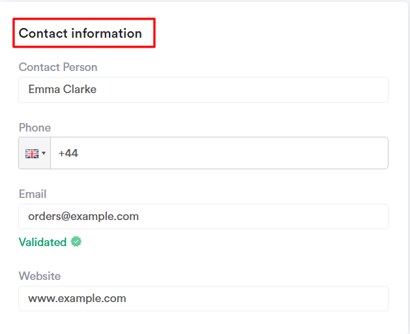
- Contact information
- Contact Person: enter the name of your contact at the supplier.
- Phone: choose the country code from the flag dropdown, then enter the phone number.
- Email: enter the supplier’s email address.
- Website: enter the supplier’s website address.
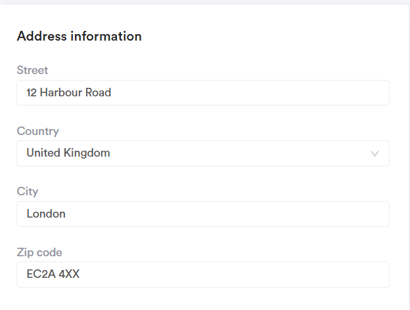
- Address information
- Street: enter the supplier’s street address.
- Country: choose the country from the list.
- City: enter the city.
- Zip code: enter the zip or postal code.
Step 4: Associate Supplier with Products
After creating the supplier, associate it with the products you purchase from them. To do so, switch back to the "Products" tab.
Click on the product you purchase from the recently created supplier.
In the General tab, select the supplier from the dropdown list that opens after clicking on the "Supplier name" field.
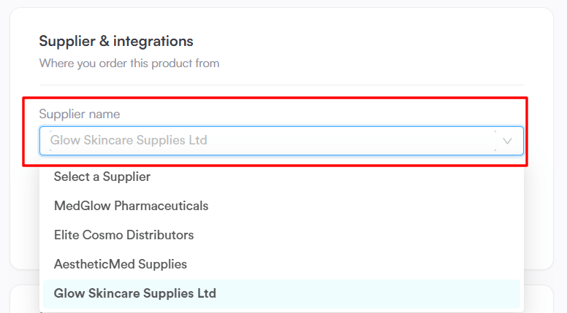
Now you've successfully created a supplier and associated it with specific products, enabling you to streamline your purchase order processes in Pabau.
How to Build a Purchase Order
Efficiently manage your inventory by creating purchase orders in Pabau. Follow these detailed steps:
Step 1: Navigate to Orders
Log in to your Pabau account and navigate to "Stock" in the left sidebar menu.
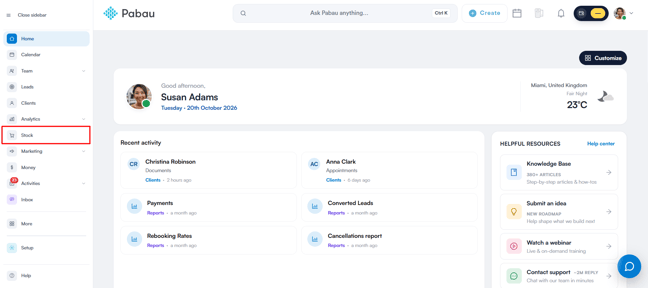
Once you open Stock, click the Orders tab at the top of the page.
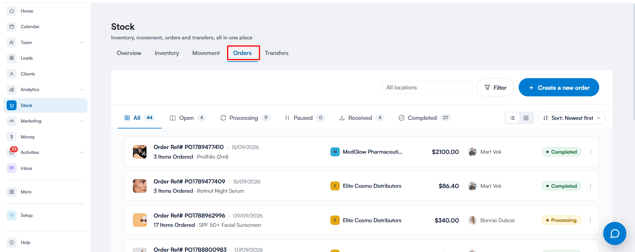
Step 2: View Purchase Orders
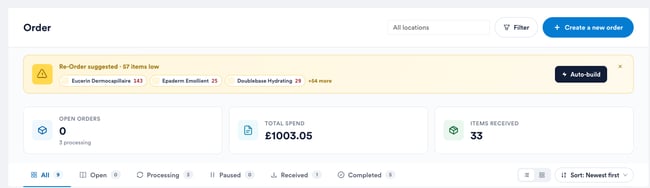
On the Orders page, you can view all of your orders. Use the status tabs – "All," "Open," "Processing," "Paused," "Received," and "Completed" – to filter the list, and the stat cards above it to see your open orders, total spend, and items received at a glance. You can also filter by location or supplier, switch between list and grid view, and sort the list. Each order card shows the order reference, the items ordered, the supplier, the total, and a status label.

Step 3: Create a New Order
To create a new order, click on "Create a new order" in the top right corner.
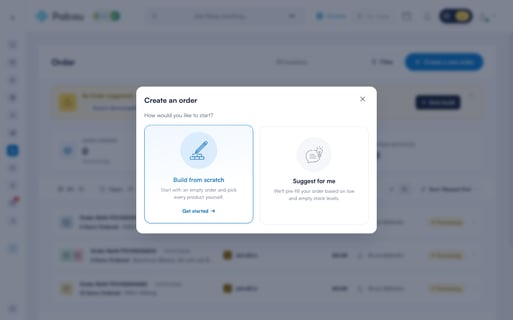
In the "Create an order" window, choose "Build from scratch" to pick every product yourself, or "Suggest for me" to have Pabau pre-fill the order based on your low and empty stock levels, then click on "Get started."
NOTE: If your account has more than one location, "Suggest for me" will first ask which location the order is for and use that location's stock levels to build the suggestions.
Step 4: Build Order from Scratch
The order builder opens in full screen. Use the filters on the left to narrow down the product list – pick a category, a supplier, or "Below par stock" to see only the products that are running low. Each product row shows its current stock level, unit cost, and supplier.
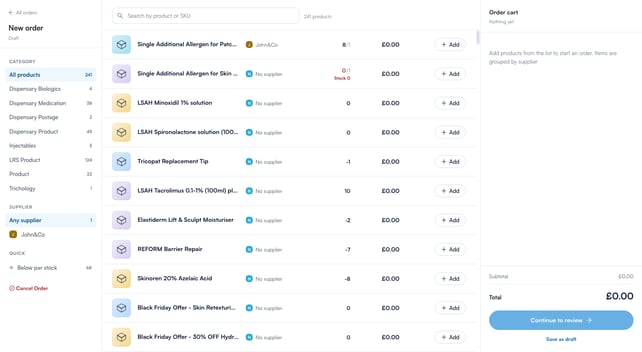
You can also use the "Search by product or SKU" bar to quickly find specific products – typing an exact SKU narrows the list down to just that product.
Step 5: Select Products and Quantities
Click on "Add" next to each product to add it to the order, then use the quantity stepper to enter the desired quantity. Added products appear in the "Order cart" on the right, grouped by supplier, with a running subtotal, VAT, and total. If you are not ready to place the order yet, click on "Save as draft" – the order will be saved under the "Paused" tab on the Orders page so you can pick it up later.
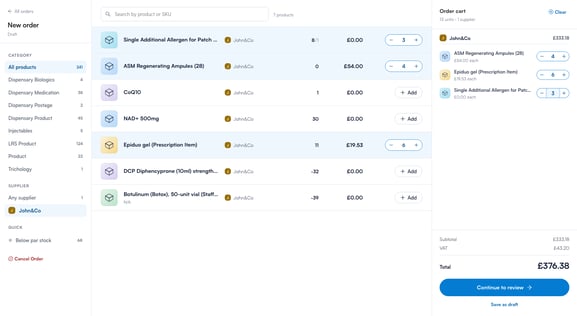
Step 6: Review and Place the Order
After selecting products and quantities, click on "Continue to review." On the "Review your order" screen, check the items for each supplier, choose the delivery location, and add any notes for your suppliers. Tick "Email purchase order to supplier" for each supplier you would like Pabau to email the order to, then click on "Place order."
NOTE: Pabau creates one purchase order per supplier, so an order containing products from several suppliers will generate several purchase orders, each with its own reference number. If any product in your order has no supplier yet, you will be asked to assign one before reviewing – the supplier you pick is saved on the product for future orders.
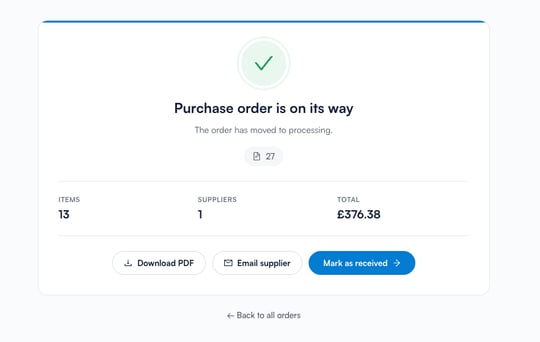
Once placed, the order moves to "Processing" and a confirmation screen appears. From there, you can download the order as a PDF, email it to the supplier, or click on "Mark as received" to go straight to the "Receive items" screen and book the delivery into stock.
Step 7: Receive and Complete the Order
The order will be displayed in Stock > Orders with a status of "Processing." When the delivery arrives, click on the order to open the "Receive items" screen. Enter the received quantity for each product, or click on "All as ordered" to fill in every line at once. You can also adjust the cost per unit if the delivery invoice differs from the ordered price, and add a note, a discrepancy reason, or a photo against any line.
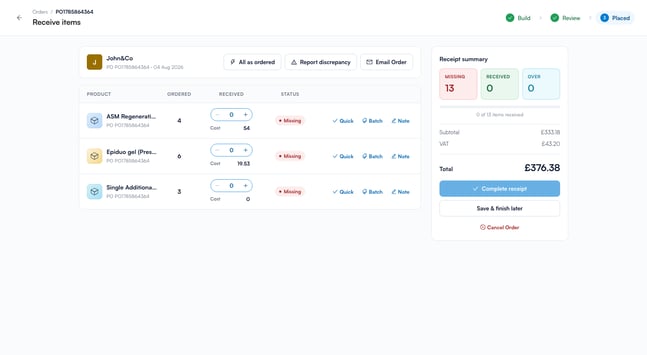
Each line shows a status label – "Missing," "Partial," "Received," or "Over" – and the receipt summary on the right tracks how many items have been received. If anything arrived damaged or short, click on "Report discrepancy" to email a discrepancy report to the supplier.
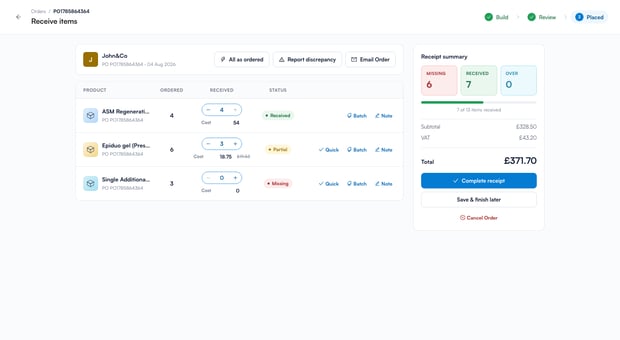
To finish, click on "Complete receipt" and confirm – the received items are added to your stock, and once every item has been received the order is marked as "Completed." Any items still outstanding when you complete the receipt are flagged as missing, and the order is marked as "Part Received."
If you are still waiting on part of the delivery, click on "Save & finish later" instead – the items received so far are booked into stock and the order stays under the "Received" tab as "Part Received" until the rest arrives.
How to Start a New Inventory Count
In this article, you will learn how to maintain precise inventory levels by initiating a new inventory count in Pabau.
Step 1: Navigate to Inventory Count
Log in to your Pabau account and navigate to "Stock" in the left sidebar menu, then click on "Inventory".
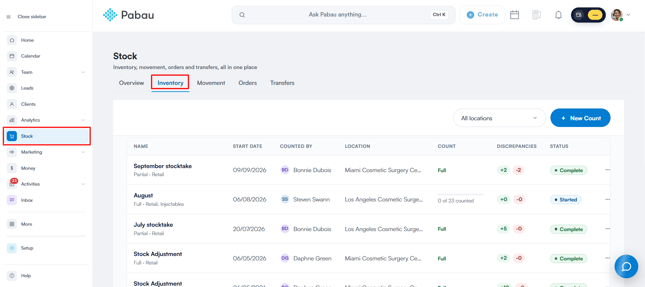
Step 2: Review Inventory Status
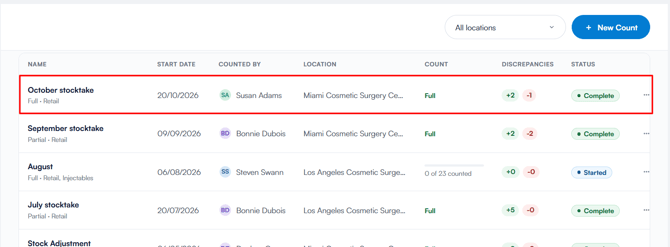
The Inventory Count page lists your stock counts. The Count column shows how many items have been counted, or Full once the count is finished. Discrepancies shows the differences found between expected and counted stock, and Status shows where the count is, for example Started or Complete.
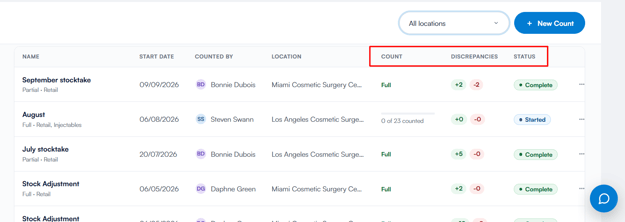
Step 3: Start a New Count
To start a new count, click on "+ New Count" in the top right of the page.
Step 3: Set Up Your Count
When you click “+ New Count”, the “New count” page opens on the “Set up” step. Here you choose what to count and where, then start the count.
-
What are you counting?
Choose the type of products you want to count: “Retail” for products you sell to clients, “Consumables” for products used during treatments, or “Injectables” for injectable substances.
-
Count name and location
Enter a name for the count in the “Count Name” field, for example “October stocktake”. Then choose the location you’re counting from the “Selected Location” dropdown.
-
Count scope
Choose “Full count” to include all the products in this count, or “Partial count” to choose which products to include.
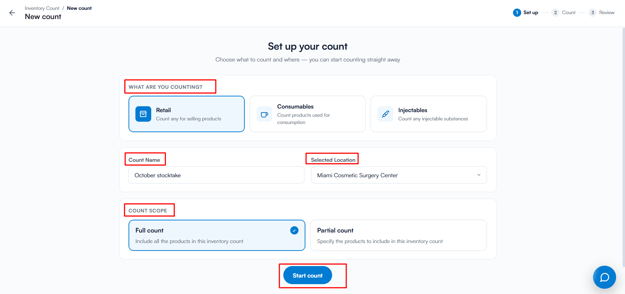
When you’ve filled in everything, click “Start count”.
Step 4: Count Your Stock
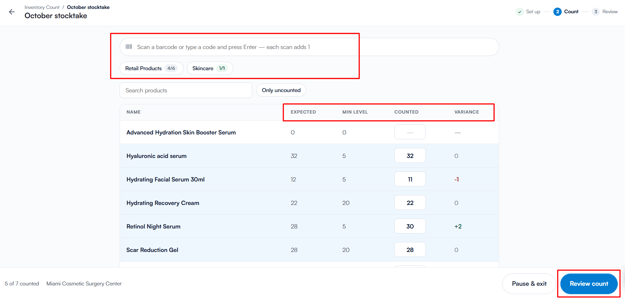
When you click “Start count”, the count opens on the “Count” step. The list shows the products included in the count, and you enter how many of each you have on the shelf.
-
Scan or search for products
At the top of the page, scan a barcode, or type a code and press Enter, to add the product to the count. Each scan adds 1. You can also use “Search products” to find a product by name. Click “Only uncounted” to show just the products you haven’t counted yet.
-
Categories
Below the scan bar, you’ll see the product categories in this count, for example “Retail Products” and “Skincare”. The numbers next to them show how many products in each category you’ve counted so far.
-
Enter your counts
For each product, the table shows the “Expected” quantity Pabau has in stock and the “Min level” you’ve set for the product. Enter the quantity you’ve counted in the “Counted” field. The “Variance” column then shows the difference between what you counted and what was expected.
-
Progress and saving
At the bottom of the page, you can see how many products you’ve counted and the location the count is for. Click “Pause & exit” to leave and finish the count later. When you’ve counted everything, click “Review count” to move on to the next step.
Step 5: Review and Complete the Count
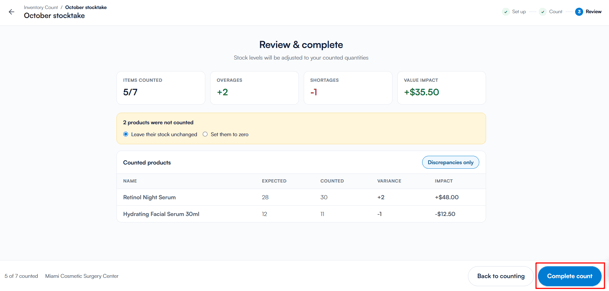
The “Review & complete” page shows what your count will change before anything is saved. Stock levels are adjusted to the quantities you counted once you complete the count. Click ''Complete count'' to finalize.
Step 6: Check the Result
Now your stock levels have been updated. It shows how many items were counted, the discrepancies found and the value impact. Click “Back to inventory” to return to your stock.
Step 7: View Inventory Count Details
The completed count will appear in your Inventory Count list. Details such as Count Start Date, performing staff member, location, count result, and any discrepancies will be visible.
By following these steps, you can perform inventory counts in your Pabau account.
Was this guide helpful? Let us know by voting below - your feedback helps us write clearer articles.
For more guides, browse the related articles below or use the search bar at the top of the page. You can also watch our video learning series, the Pabau Academy, or visit the Support page for additional help.