
Audit Corrections are part of the End of Day report in Pabau. They are designed to give clinics visibility into any changes, adjustments, or discrepancies made on invoices and transactions after the initial billing. This ensures full transparency and helps managers or auditors confirm that all billed items match what was sold and paid for.
Step 1: Navigate to Reports
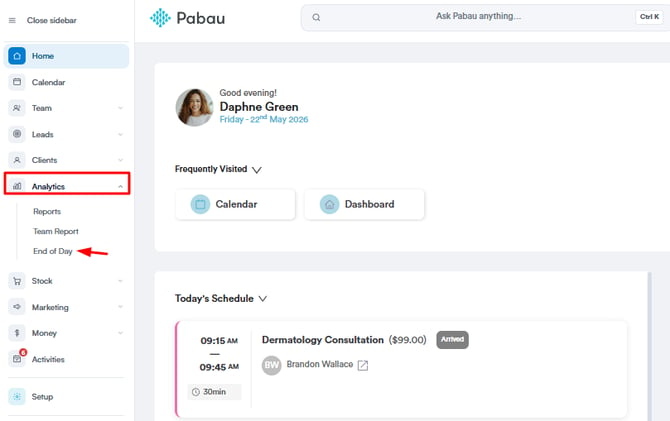
Start by logging into your Pabau account using your login credentials. Then, navigate to the left sidebar menu. Click to expand the "Analytics" tab. Under the "Analytics" tab, you'll see the "End of Day" sub-tab listed.
Step 2: Click Audit Corrections
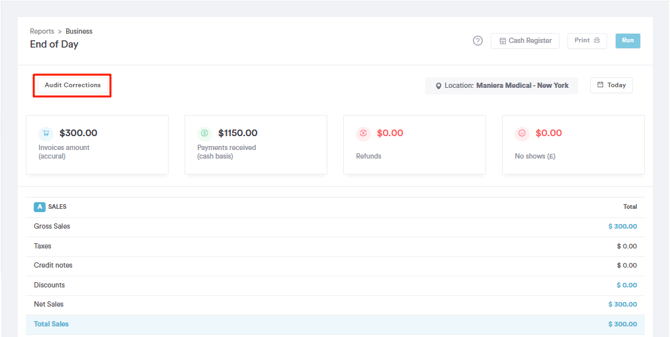
Navigate to the top left corner of the screen and click the "Audit Corrections" button. This opens the Audit Corrections report.
Step 3: Filter the Report
At the top of the report you'll find three filters — Date, Location, and Employee. The report refreshes automatically as soon as you change a filter.
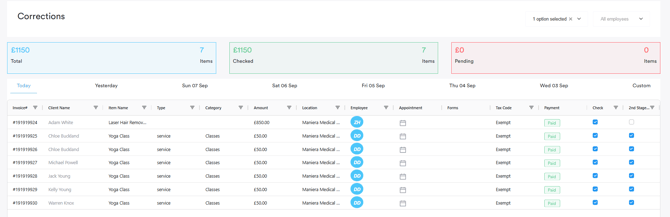
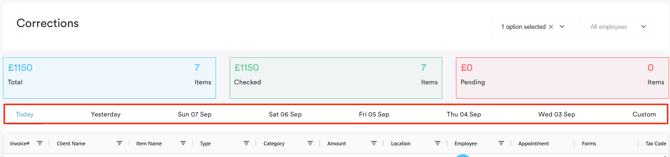
To filter by date, click the "Date" filter to open the date-range picker. It defaults to the last 30 days, and the preset rail gives you quick picks for Today, Last 7 days, Last 30 days, Last 90 days, and This year — or select any custom range on the calendar.
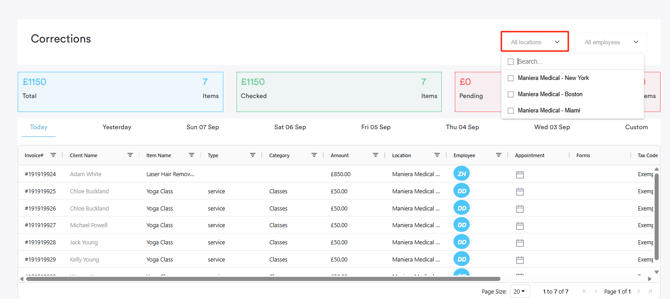
To filter by location, click the "All locations" filter. By default, it's set to show all locations. To view specific locations, open the dropdown and tick the locations you want to see.
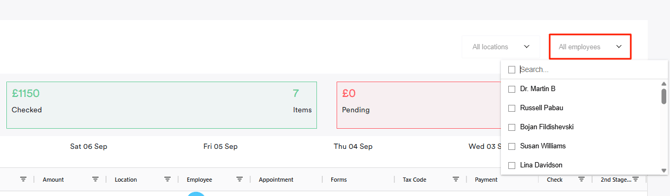
To filter by staff, click the "All employees" filter. By default, all employees are included, but if you want to view data for specific team members, open the dropdown and tick the names you'd like to see — you can type in the search box to find someone quickly.
NOTE: Earlier versions of this page offered filter menus on each column, with operators such as "Equals" or "Greater than". In the current report, filtering is done with the Date, Location, and Employee filters described above.
Step 4: Review the Summary and Columns
Above the table, three summary tiles total up everything matching your filters:
- Total – The combined amount and item count of all sale items in the filtered period.
- Checked – The amount and item count of items that have already been ticked as checked.
- Pending – The amount and item count of items still waiting to be checked.
The table below shows one row per sale item, with the following columns:
| Column | What it shows |
|---|---|
| Invoice# | The invoice number of the sale — click it to open the invoice. |
| Client Name | The client the item was billed to. |
| Item Name | The service, product, or other item that was sold. |
| Type | The kind of item sold (for example, a service or a product). |
| Category | The category the item belongs to. |
| Amount | The line amount for the item. |
| Location | The location where the sale was made. |
| Employee | The staff member associated with the sale. |
| Appointment | The related appointment — if one isn't linked yet, you can assign it right from the row. |
| Forms | Any forms linked to the sale item. |
| Tax Code | The tax code applied to the line — editable inline (see Step 6). |
| Payment | How the item was paid. |
| Check | The first-stage audit checkbox. |
| 2nd Stage Review | The second-stage sign-off checkbox. |
Step 5: Check Data
In the "Check" and "2nd Stage Review" columns, you can tick the checkbox to confirm that the data has been reviewed. This step is important for Audit Corrections because it:
-
Confirms the entry has been checked by staff.
-
Prevents items from being overlooked or missed.
-
Creates an audit trail showing who verified the data and when.
-
Ensures accuracy before finalizing the End of Day report.
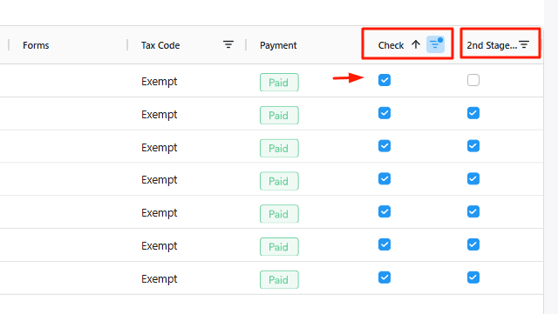
A few rules keep the audit trail reliable:
- Ticking a box is an audit marker only — it never changes the invoice itself.
- Hover over a ticked box to see who reviewed the item and when (for example, "Checked on 04-08-2026 14:30 by Emma Thompson" or "Confirmed on 04-08-2026 16:05 by Emma Thompson").
- A Check tick can only be removed by the person who made it, and only on the same day it was made.
- 2nd Stage Review only becomes available once an item has been checked, so it can act as a two-person sign-off.
Step 6: Correct a Tax Code
If a sale item was billed with the wrong tax code, you can fix it directly from the report. Click the value in the "Tax Code" column and select the correct code from the dropdown. The dropdown is available on service and product lines; other item types show their tax code as read-only text. The line's tax and gross totals recalculate automatically, following your company's tax-inclusive or tax-exclusive pricing setting.
Step 7: Export, Print, and More
In the top-right corner of the report you'll find the toolbar actions:
- Columns – Opens the column manager (this report’s columns are fixed).
- Export – Download the report as an Excel or CSV file (the file name starts with "corrections").
- Print – Open your browser's print dialog.
- Help – Open the in-app help guide for this report.
- Refresh – Re-run the report with your current filters.
By following these steps, you can maintain a complete and reliable audit trail for every transaction.
For more guides, refer to related articles below, select additional guides, or use the search bar at the top of the page. These guides will help you get the most out of your Pabau account.
Additionally, to help you fully utilize and understand your Pabau account, we recommend exploring additional guides and resources offered at the Pabau Academy. It offers in-depth video tutorials and lessons, offering a holistic learning experience that can equip you with the essential skills for achieving success with Pabau.