
Table of Contents:
1. How to Set a Default Code Set
2. How to Use Diagnostic Codes in Treatment Forms
3. How to Search and View Diagnostic Codes
4. How to Use Diagnostic Code Tagging
Diagnostic Codes in Pabau help you record clinical findings accurately and meet insurance, reporting, and compliance requirements.
With this feature, you can:
-
Browse a full library of standardized code sets (ICD11, ICD10, ICD9, CCSD, ISC, SNOMED CT)
-
Search codes quickly and see their descriptions
-
Use diagnosis codes directly inside treatment forms
-
Automatically link diagnoses to appointments
-
Choose a default code set for your clinic
-
Create and manage custom diagnostic code sets
Diagnostic coding is fully integrated into the clinical workflow to help you document care efficiently and consistently.
How to Set a Default Code Set
Step 1: Navigate to Setup
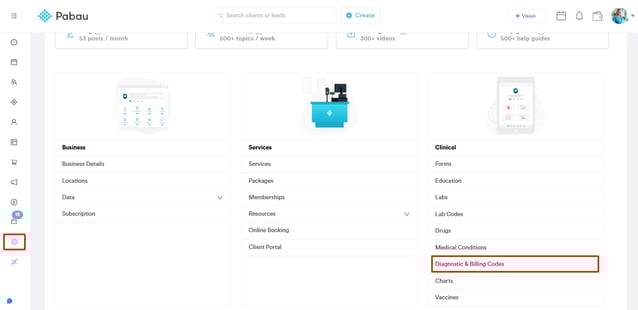
Start by logging into your Pabau account using your login credentials. Then, navigate to Setup, under the Clinical section, find the Diagnostic & Billing Codes tab.
Step 2: View Available Code Sets
When you open Diagnostic & Billing Codes, you’ll see a list of static code sets:
-
ICD11
-
ICD10
-
ICD9
-
CCSD
-
ISC
-
SNOMED CT (view-only)
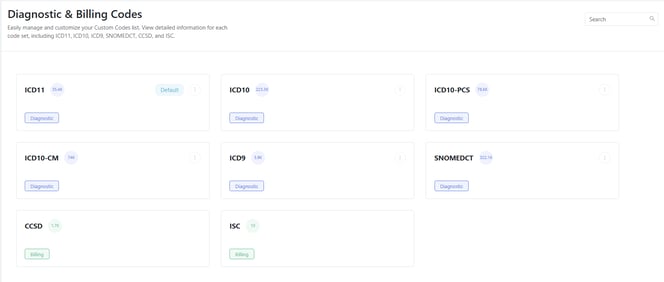
These code sets cannot be edited or deleted. Click any code set to open its detail page.
Step 3: Set a Default Code Set
Your clinic can set a default diagnostic system, but only for:
-
ICD11
-
CCSD
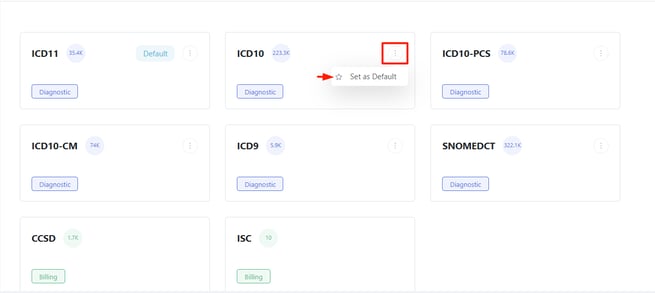
Pabau saves this setting in your company preferences. To set a default code, click on the three dots next to the code; this will reveal the "Set as Default" option.
NOTE: The default code set is used when searching for diagnosis codes (e.g., when adding client problems). If no default is set, Pabau will search ICD11 only.
How to Use Diagnostic Codes in Treatment Forms
Step 1: Navigate to the Client Card
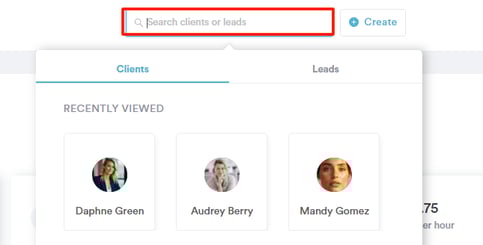
Start by logging into your Pabau account using your login credentials. Then, navigate to the search bar at the top of the screen. Type in the client name, and the client card will appear in the search results.
Step 2: Write Treatment Note
Click the "Create" button located in the bottom right corner of the screen. This will reveal the "Write a treatment note" option.
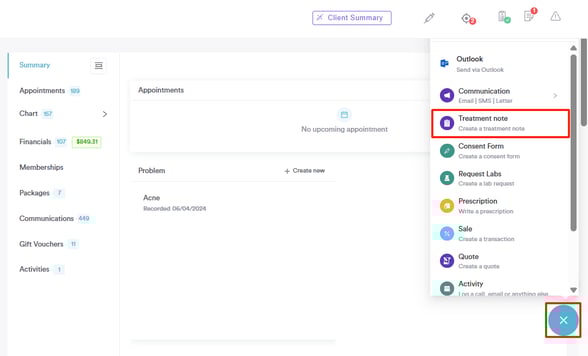
Step 3: Open the Diagnostic Picker (dX)
While the treatment form is open for that appointment, look for the dX button labeled “Choose diagnosis codes” (on the bottom of the form).
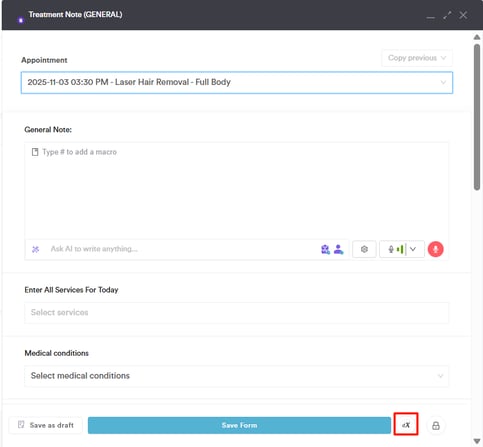
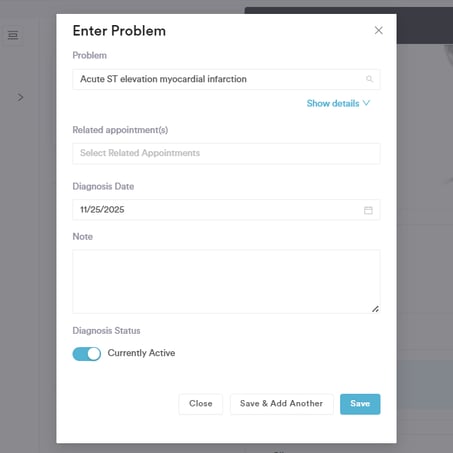
When you click the dX button, the Create Problem window will pop up. Some information is already filled in for you: the diagnosis date defaults to today, and the related appointment is automatically linked to the one you’re working on.
In the modal, use the search box to find the code you need by typing either the code or a description. The search will look through your clinic’s default code set, or ICD11 if no default has been set. You’ll see a placeholder that says something like “Search ICD11 codes”.
- Click on the code(s) you want to add.
- You can also add any extra notes if needed.
- You can deactivate the diagnosis by disabling the "Currently Active" toggle.
- When you’re done, either Create to save the code and close the window, or Save & add another if you want to add more diagnoses before closing.
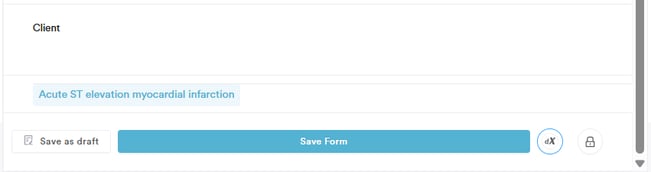
If you clicked Create, the modal closes and the newly created diagnosis label(s) appear on the treatment form (visible near the bottom header or in the diagnosis area).
If you clicked Save & add another, the modal stays open so you can add extra diagnoses; when finished, close the modal, and you’ll see all labels added.
Step 4: Review Diagnose
Click to expand the Chart/EMR tab. This will reveal the "Client Problems" sub-tab. Diagnoses created from the treatment form are stored as Client Problems (client-level problems).
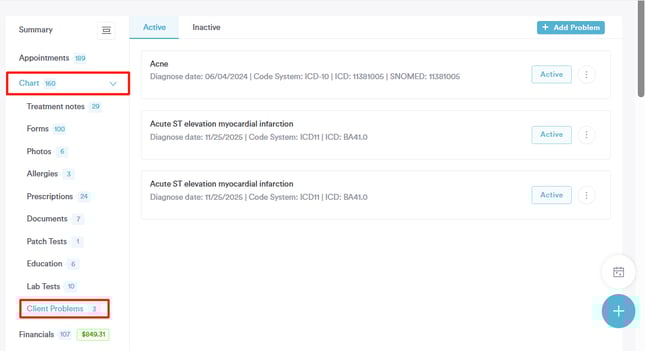
By following these steps, you can add diagnoses while writing treatment notes in Pabau.
How to Search and View Diagnostic Codes
Step 1: Navigate to Setup
Start by logging into your Pabau account using your login credentials. Then, navigate to Setup, under the Clinical section, find the Diagnostic & Billing Codes tab.
Step 2: View Available Code Sets
When you open Diagnostic & Billing Codes, you’ll see a list of static code sets:
-
ICD11
-
ICD10
-
ICD9
-
CCSD
-
ISC
-
SNOMED CT (view-only)
These code sets cannot be edited or deleted. Click any code set to open its detail page.
Step 3: Choose a Code Set
Start by selecting the code set that contains the code you’re looking for. This will open the list of codes so you can easily search and find the right one.
Step 4: Navigate to the Search Bar
Use the search bar located at the top right corner to quickly find a code in the code set by typing a description or code. Codes are read-only, so you can only view them and select them for client problems.
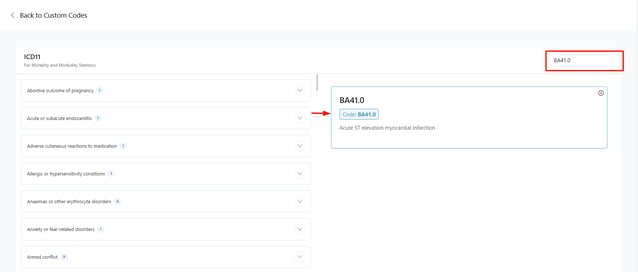
-
For ICD11, codes are grouped in 3 layers (Layer 1 → Layer 2 → Layer 3) for easier navigation.
-
For ISC, codes are categorized first by Chapter, then Category.
-
ICD10, ICD9, CCSD, and SNOMED CT show a flat searchable list with no categories.
By following these steps, you can easily search for diagnostic codes in Pabau.
How to Use Diagnostic Code Tagging in Pabau
Diagnostic code tagging allows you to group frequently used codes, making them faster to find when adding diagnoses for clients.
Step 1: Navigate to Setup
Start by logging into your Pabau account using your login credentials. Then, navigate to Setup, under the Clinical section, find the Diagnostic & Billing Codes tab.
Step 2: View Available Code Sets
When you open Diagnostic & Billing Codes, you’ll see a list of static code sets:
-
ICD11
-
ICD10
-
ICD9
-
CCSD
-
ISC
-
SNOMED CT (view-only)
These code sets cannot be edited or deleted. Click any code set to open its detail page.
Step 3: Choose a Code Set
Start by selecting the code set that contains the code you’re looking for. This will open the list of codes so you can easily search and find the code you want to tag.
Step 4: Add Tag
Click the + sign on the right side of the code. This will reveal the option to add a tag. Enter a tag name to create a group for that code.
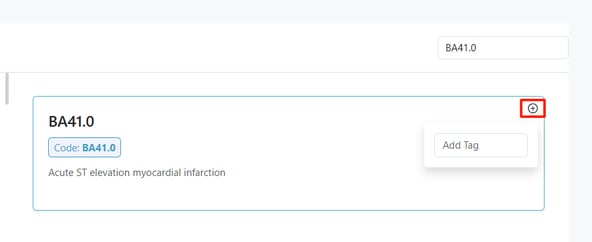
If you have the code BA41.0 (for example purposes, it’s an ICD10/ICD11 code for Streptococcal pharyngitis). You could create a tag that groups it with other similar or frequently used codes.
Possible tags for BA41.0:
-
“Throat Infections” – groups all throat-related infections
-
“Common Infections” – for frequently seen bacterial infections
-
“ENT Conditions” – if your clinic organizes codes by specialty
After adding the tag, press the Enter key on your keyboard. The tag will now show on the code.
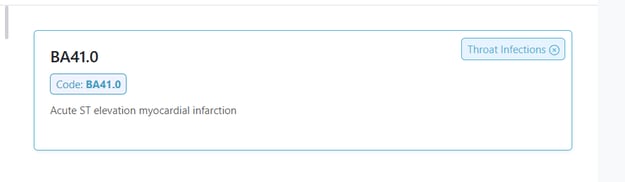
NOTE: Tagging does not enable or disable a code at the system level; it is only used for grouping and filtering purposes.
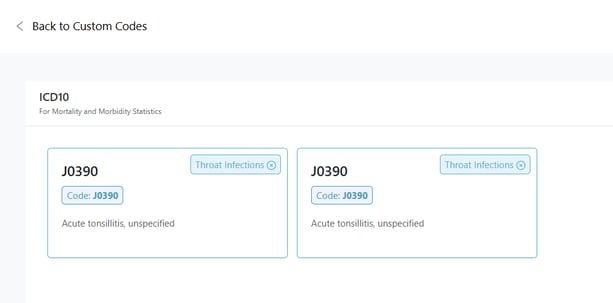
If you add “Throat Infections” as a tag, you could also tag codes like:
-
J02.0 – Streptococcal tonsillitis
-
J03.9 – Acute tonsillitis, unspecified
-
J06.9 – Acute upper respiratory infection, unspecified
-
BA41.1 – Other bacterial pharyngitis (depending on your code set)
Basically, any code that falls under the same clinical category or workflow group can share the tag. Use the search bar to find the codes in the appropriate code set and proceed to add the same tag "Throat Infections."
By following these steps, you can tag diagnostic codes in Pabau.
For more guides, refer to related articles below, select additional guides, or use the search bar at the top of the page. These guides will help you get the most out of your Pabau account.
Additionally, to help you fully utilize and understand your Pabau account, we recommend exploring additional guides and resources offered at the Pabau Academy. It offers in-depth video tutorials and lessons, offering a holistic learning experience that can equip you with the essential skills for achieving success with Pabau.