
The Gift Card Report is the transaction-level view of your gift card programme — every gift card sold, who bought it, its face value, how much has been redeemed or refunded, and the balance remaining on each card.
It answers: which gift cards were sold in a period, who bought each one, how much of each card has been spent, refunded or lost to expiry, and what balance is still outstanding — card by card.
For example, if a client buys a "Holiday £100" gift card on 14 June and spends £60 of it in July, the report shows Value £100.00, Redeemed £60.00, Balance £40.00 and a "Partially Redeemed" status.
NOTE: Looking for the total outstanding gift card balance on your books instead? That's the Gift Card Liability report — the balance-sheet view of your liability at a point in time. This report is the per-card transactional view.
How to find it
Step 1: Navigate to the Analytics Feature
Log in to your Pabau account, and in the left sidebar menu, go to Analytics, then click on the "Reports" button.
Step 2: Access the reports banner
On the "Try our new suite of reports" banner, click Try it now.
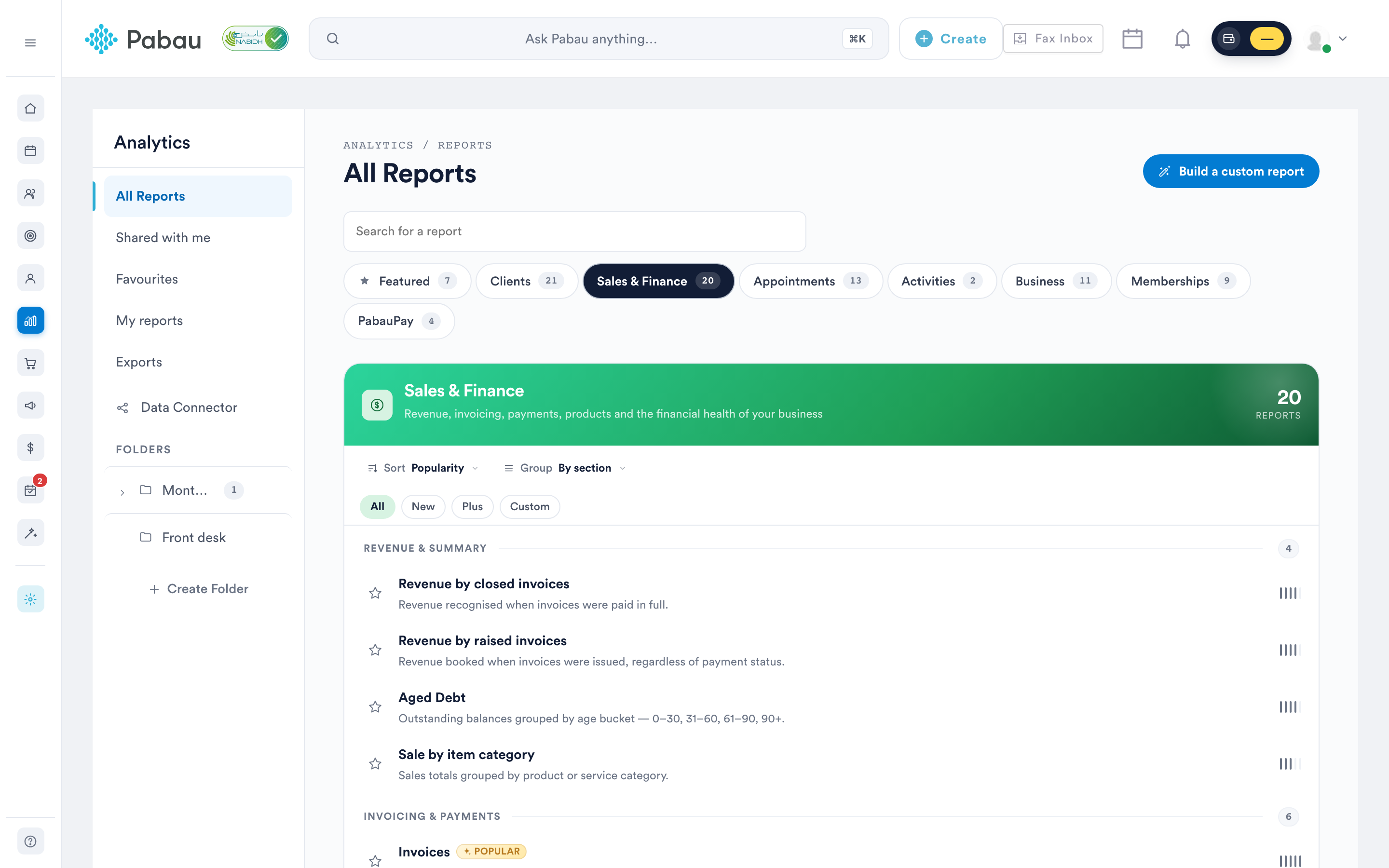
Once you're in the new reports view, go to the Sales & Finance section, scroll to the "Tax, commissions & gift cards" group, and click on Gift Card Report (marked New) to open the report. This report is part of the new reports suite only — it doesn't appear in the classic reports list.
Toolbar controls
| Button | What it does |
|---|---|
| Columns | Opens the column manager — show or hide any of the 15 table columns. Your choice is remembered in your browser for this report. |
| Export | Downloads the table as a CSV file (e.g. gift-cards-2026-08-04.csv). |
| Opens your browser's print dialog with a print-friendly layout. | |
| Help | Opens the in-app help modal — an overview, how-to steps, and a definition of every column. |
| Refresh | Re-runs the report with your current filters, showing "Refreshing…" while loading. |
There's also a search box above the table — "Search by client, gift card #, invoice…" — which matches the client name, the gift card number, or the invoice number, so you can jump straight to a specific voucher.
Filters
- Dates – The sale-date range the report analyses. Defaults to the last 30 days, with presets for Today, Last 7 days, Last 30 days, Last 90 days, and Year to date, or a custom range.
- Sale Location – Optional, single-select, searchable. Only lists the branches your user is permitted to access.
- Status – Optional, multi-select: Active, Partially Redeemed, Fully Redeemed, Expired, Refunded. Defaults to All statuses.
- Inc. Tax – Checkbox, ticked by default. Controls whether the footer's Total Sales figure includes tax (see the totals section below).
- Inc. Refunded – Checkbox, unticked by default. Refunded gift cards are hidden until you tick it.
NOTE: Because refunded cards are excluded by default, selecting the "Refunded" status on its own shows nothing — tick Inc. Refunded first, then use the Refunded status or chip to isolate them.
Status quick filters
A chip strip above the table gives you one-click status toggles: All, Active, Partially Redeemed, Fully Redeemed, Expired and Refunded. Click a chip to show only cards in that status; click All to reset.
Understanding the report
The table
Each row is one gift card. You'll find a definition of every column in the Help modal.
| Column | What it shows |
|---|---|
| Sale Location | The location at which the gift card was sold. |
| Invoice No | The invoice the gift card was sold on. Click it to open an invoice preview without leaving the report. |
| Gift Card Name | The gift card's template name (e.g. "Holiday £100") or the voucher description. |
| Gift Card # | The unique voucher code printed on the card. |
| Client | The client the voucher was purchased for. Click the name to open their client card. |
| Sale Date | The date the voucher was purchased. |
| Expiry Date | The date the voucher expires. Shows "No Expiry" for vouchers that never expire; expired dates are highlighted. |
| Sales | The net sale price, excluding tax. |
| Sales (Inc. Tax) | The final sale price including tax. |
| Value | The face value loaded onto the voucher. |
| Redeemed | The total amount already used against bills. |
| Refunded | The refunded amount — the full face value if the voucher was refunded. Shown in red when greater than zero. |
| Expired | The balance that was still remaining at the point of expiry. Shown in red when greater than zero. |
| Balance | The current unspent balance on the card. |
| Status | A badge derived from the card's balance, expiry and refund state — Active, Partially Redeemed, Fully Redeemed, Expired or Refunded. |
The totals row
Beneath the table, the footer totals the currently filtered cards, alongside a results count (e.g. "42 cards"):
- Total Sales – The sales total for the filtered cards. With Inc. Tax ticked (the default) this is the tax-inclusive total; untick it to see the net total instead.
- Total Value – The combined face value loaded onto the filtered cards.
- Total Redeemed – The combined amount already spent from them.
- Total Balance – The combined unspent balance still outstanding.
For example, to review last quarter's gift card sales at one branch: set Dates to the quarter, pick the branch under Sale Location, and read Total Sales for revenue, then compare Total Redeemed against Total Balance to see how much of that value has actually come back through the till.
NOTE: The Sales & Finance section of the new reports catalog is visible to users who hold the "Can access sales company reports" or "Can access financial company reports" permission. There is no separate per-report permission or feature flag — only the location scoping described above.
With this understanding, you can confidently use the Gift Card Report to track every voucher from sale through redemption to its final status — and pair it with the Gift Card Liability report when you need the outstanding-balance view for your accounts.
Was this guide helpful? Let us know by voting below - your feedback helps us write clearer articles.
For more guides, browse the related articles below or use the search bar at the top of the page. You can also watch our video learning series, the Pabau Academy, or visit the Support page for additional help.