
On the CMS-1500 claim form, Box 11 and its sub-boxes describe the insured person's policy: the policy group or FECA number (11), the insured's date of birth and sex (11a), the plan name (11c), and whether another health benefit plan exists (11d). This guide explains what each box means and how Pabau fills it.
NOTE: This article is part of the US Insurance Billing Additional Resources series, which walks through every box of the CMS-1500. If you are new to claims in Pabau, start with Creating a US Professional (CMS 1500) Claim.
Box 11 — Insured's policy group or FECA number

Box 11 holds the policy's group number — a different number from the member ID in Box 1a. The member ID identifies the person; the group number identifies the employer or group plan the policy belongs to, and it usually appears on the insurance card next to the member ID. Not every policy has one, though some payers require it on submissions. For claims billed under the Federal Employees' Compensation Act, the FECA number goes in this box instead.
How Pabau fills it
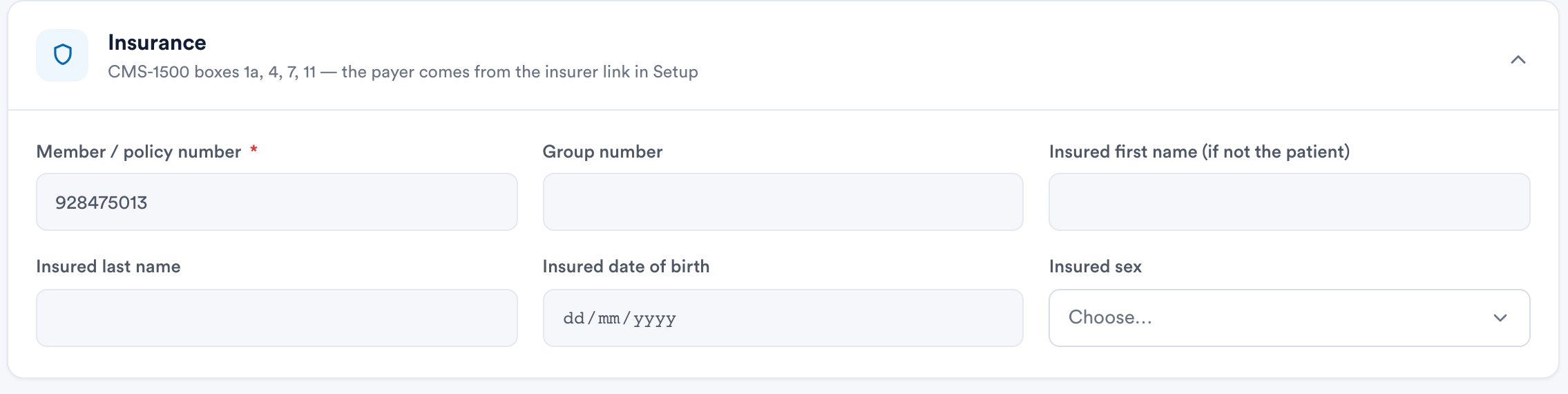
The claim's Insurance section (CMS-1500 boxes 1a, 4, 7, 11) has a Group number field. The value comes from the group ID on the client's insurance policy — open the Insurance tab of the left panel on the client card to see each policy — and you can correct it on the claim itself before validating or sending. For a FECA claim, enter the FECA number in the same field.
TIP: Do not put the member ID here — that belongs in Box 1a as the Member / policy number. See Box 1 – Insurance Coverage Type for how that box is filled.
Box 11a — Insured's date of birth and sex

Box 11a carries the policy holder's date of birth and sex as the insurance company has them on file. When the patient is their own policy holder, this box repeats the patient's details from Box 3.
How Pabau fills it
The Insurance section has matching Insured date of birth and Insured sex fields. When the patient holds the policy, leave them blank — Pabau mirrors the patient's details automatically, just as it does for the insured's name in Box 4. When someone else holds the policy, enter that person's date of birth and sex here.
On the electronic claim: the same mirroring applies, so the insured's details are always complete when the claim is sent.
Boxes 11b, 11c, and 11d
Box 11b (Other claim ID): Pabau always leaves this box blank. If a payer requires a value, add it in the Claim.MD portal after sending, or hand-fill the printed form.
Box 11c (Insurance plan or program name): there is no separate plan-name field in Pabau. On the printed form, Pabau prints the payer name as the plan name.
Box 11d (Is there another health benefit plan?): Pabau marks neither YES nor NO. Additional coverage is handled by creating a secondary claim once the primary payer has paid — see Submitting Secondary Claims in Pabau.
To set up client insurance policies and their group numbers, see Insurance Guide Part 2: Client Insurance Setup in Pabau.