
On the CMS-1500 claim form, Box 10 asks whether the patient's condition is related to employment, an auto accident, or another accident. Payers read it to decide whether someone else — workers' compensation or an auto insurer, for example — should pay before they do. This guide explains sub-boxes 10a through 10d and where Pabau takes the answers from.
NOTE: This article is part of the US Insurance Billing Additional Resources series, which walks through every box of the CMS-1500. If you are new to claims in Pabau, start with Creating a US Professional (CMS 1500) Claim.
Box 10 — Is the patient's condition related to
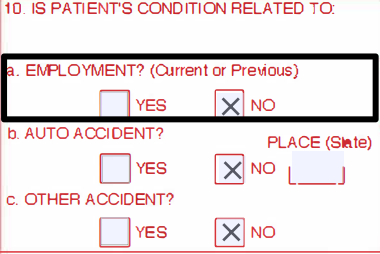
The box carries three YES / NO pairs — 10a Employment (current or previous), 10b Auto accident, which also has a PLACE (State) cell for where the accident happened, and 10c Other accident — and exactly one of YES or NO is marked for each. Below them, 10d Claim codes is reserved for NUCC-designated codes and is rarely used.
How Pabau fills it
The answers live on the claim itself, in the Claim details section (labelled on screen with its CMS-1500 boxes: 10, 22, 23, 27). Two selects drive the box: Employment related (10a) and Auto accident (10b). Both default to No, which is what most claims need — you only change them when the condition genuinely stems from work or a crash.
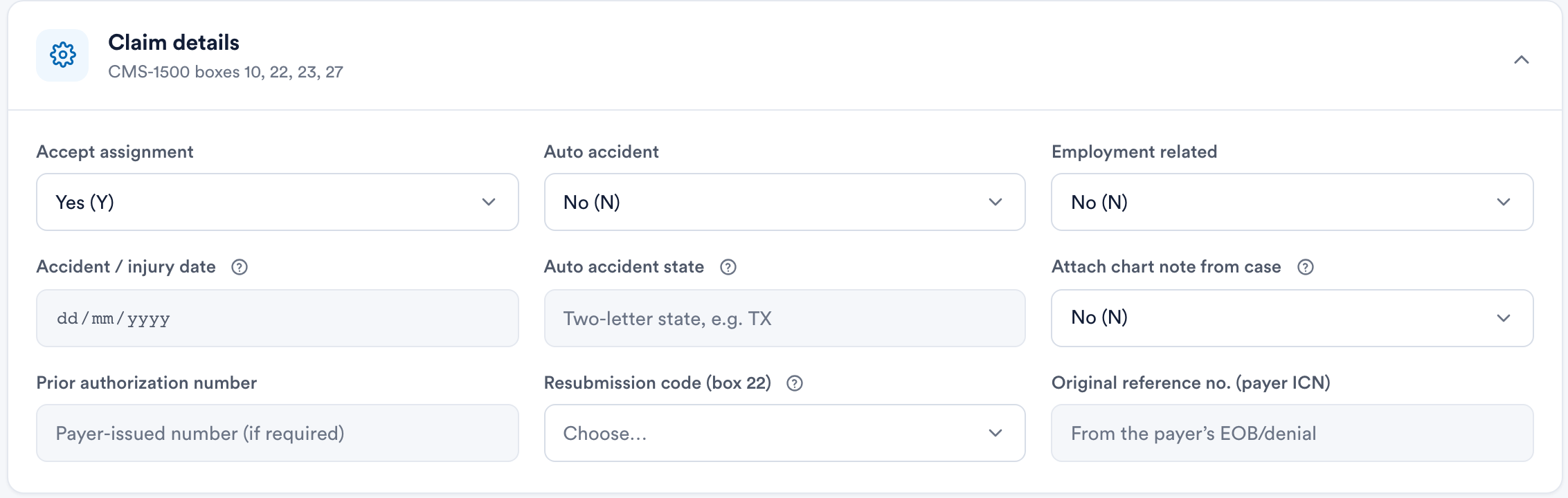
Answering Yes brings two more fields into play:
- Auto accident state — required when Auto accident is Yes. Enter the two-letter state where the accident happened (TX, CA, and so on); it prints in 10b's PLACE (State) cell.
- Accident / injury date — required whenever Auto accident or Employment related is Yes. It does not print in Box 10: it lands in Box 15 with the accident-date qualifier. See Box 15 – Other Date.
On the electronic claim: the same answers travel as the employment-related and auto-accident indicators, together with the two-letter accident state.
Boxes 10c and 10d — Other accident and claim codes
Pabau always prints NO in 10c — there is no Other accident field on the claim — and leaves 10d blank. Both are the right answer for the vast majority of professional claims. If a payer genuinely needs 10c marked YES, update the claim in the Claim.MD portal after sending (Manage Claim), or hand-fill the printed form.
CAUTION: Answer Yes only when the condition truly relates to the patient's work or an accident. Payers use Box 10 to decide whether other coverage — workers' compensation or an auto insurer — should be billed first, so a stray Yes can send your claim down the wrong path.
Unsure about the terms payers use around accident and workers'-compensation claims? The Insurance Billing Glossary has plain-English definitions.